
Advancing Independent Research on Leadership Behavior, Drift, and AI-Augmented Execution Systems
The Leadership Execution Institute investigates how leaders think, decide, and behave in modern work environments, and how artificial intelligence can create risk or value depending on how it is applied. Our research focuses on the behavioral patterns that influence leadership consistency, organizational alignment, and execution quality as expectations rise and pressure increases drift.
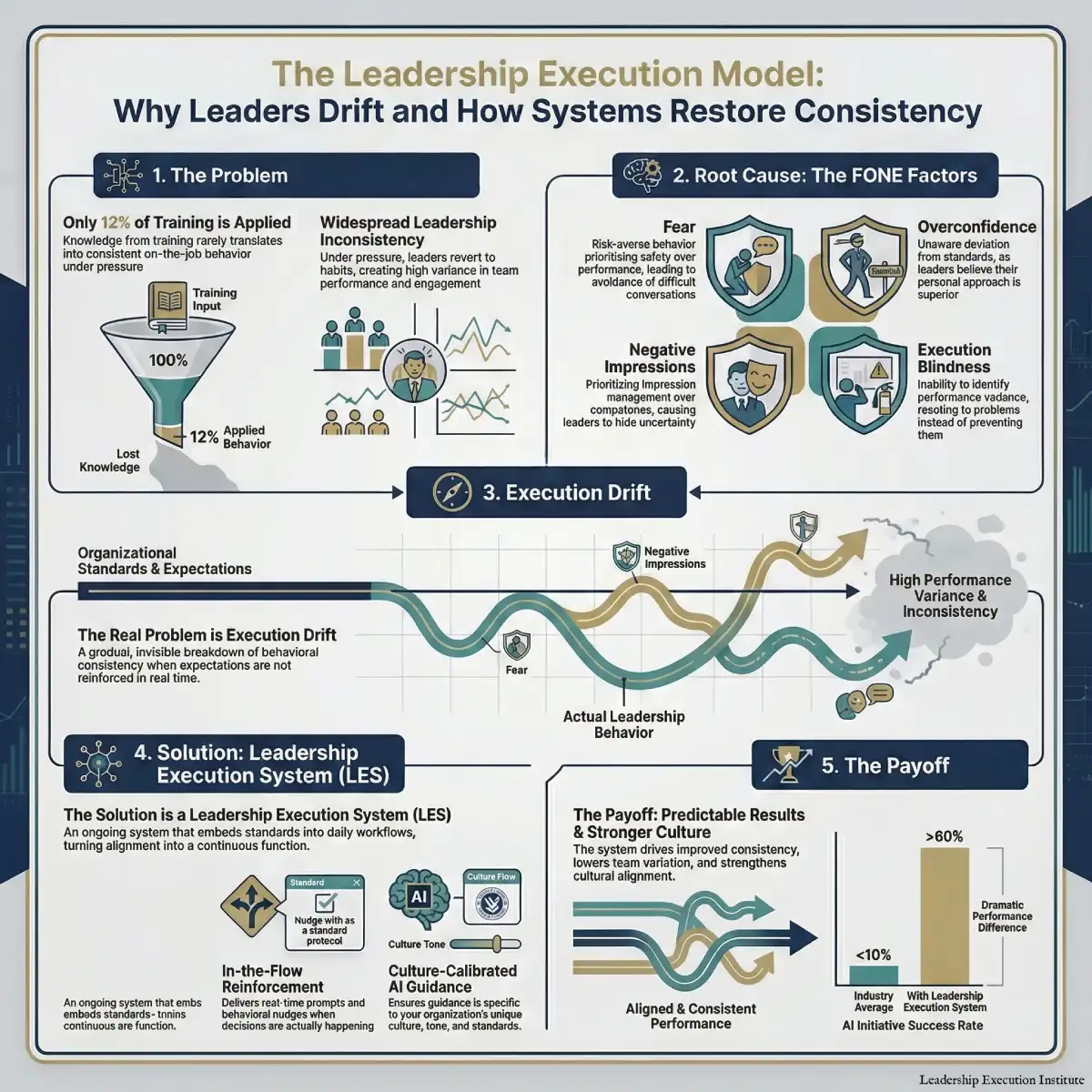
Using applied behavioral science, field studies, and cross-industry diagnostic models, we examine why leadership behaviors drift, how decision quality changes as demands increase, and how Leadership Execution Systems and culture-calibrated AI can strengthen consistency at scale. This includes evaluating why traditional leadership training fails to produce lasting behavioral change and how system-based approaches create more reliable results.
Our mission is to generate insights that help organizations create conditions where leaders perform with clarity, alignment, and confidence in an environment where AI is rapidly reshaping how decisions are made and reinforced.
Core Areas of Leadership Research and Analysis
Leadership Variability Research
Research examining why leaders behave inconsistently under pressure and how variability affects team performance.
Supervisor Drift Patterns
Execution Drift Measurement Methods
Behavioral variability indicators
Leadership decision pressure points
Cultural alignment analysis
Learn MoreFONE Behavioral Science Framework
Analysis of the four human factors that distort leadership behavior and create predictable performance drift.
Fear-based avoidance patterns
Overconfidence-driven deviation
Negative Impressions and impression management
Execution blindness detection
Drift progression modeling
Learn MoreExecution System Design
Research and modeling of structured systems that improve consistency, reinforce standards, and reduce variance.
In the flow reinforcement methods
Culture-calibrated AI modeling
Decision support workflow design
Reinforcement loop engineering
Measureable consistency metrics
Learn More
Leadership inconsistency is not a skills gap. It is a behavioral pattern shaped by predictable human factors. Advancing the field requires systems that support leaders in real time.
– Leadership Execution Institute Research Summary