
Institute Frameworks
These frameworks organize how the Leadership Execution Institute studies leadership consistency, behavioral drift, and the systems that keep leaders aligned under real-world pressure. They provide a shared language for researchers, strategists, and operators who want to move beyond training content and into measurable execution.
Each model clarifies a different part of the problem: why Supervisor Drift and Execution Drift persist, how the FONE Factors shape real decisions, and how Leadership Execution Systems use culture-calibrated AI and reinforcement loops to stabilize behavior over time.
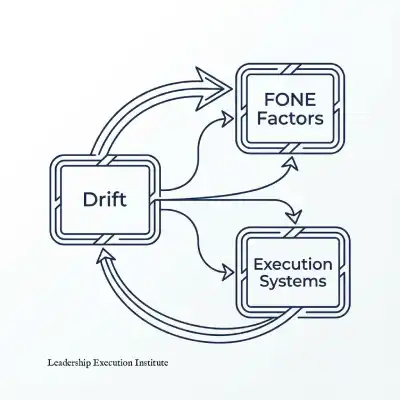
How the Institute Uses These Frameworks
The Leadership Execution Institute treats frameworks as working models, not slogans. They guide how studies are designed, how data is interpreted, and how results are translated into diagnostics, decision guides, and execution systems that can be tested in the field.
Over time, findings from applied research and practitioner feedback refine each framework so that they better explain where drift emerges, which FONE Factors are active, and which combinations of system design and reinforcement produce the most stable leadership behavior.
Core Leadership Execution Frameworks
Behavioral Drift Frameworks
Behavioral Drift frameworks explain how standards and real behavior separate over time when reinforcement is weak. They map Supervisor Drift and Execution Drift so that inconsistency can be observed, measured, and addressed as a system failure instead of a style issue.
Supervisor Drift and Execution Drift models
Drift progression and early warning patterns
Maps of variation across teams, shifts, and sites
Recovery and stabilization pathways for leaders and teams
Learn MoreFONE Factors Framework
FONE frameworks break down four forces – Fear, Overconfidence, Negative Impressions, and Execution Blindness – that reliably shape leadership behavior when the stakes feel high. They help explain why leaders who understand expectations still default to self-protection, shortcuts, or untested assumptions.
Behavioral maps for each FONE Factor
Links between FONE, Drift, and decision quality
Observation guides for real-world pattern spotting
Implications for culture, communication, and coaching
Learn MoreLeadership Execution System Frameworks
Leadership Execution System frameworks focus on how standards, culture, and guidance are embedded into daily workflows so that leaders act consistently, not just recall training. They integrate system design, culture calibrated AI, and in the flow reinforcement to reduce drift at scale.
Architecture for Leadership Execution Systems
Prompting and reinforcement patterns for daily decisions
Design principles for culture-calibrated AI guidance
Feedback loops that connect behavior, metrics, and learning
Learn MoreUsing These Frameworks in Your Own Work
If you are exploring Supervisor Drift, the FONE Factors, or Leadership Execution Systems in your own research or practice, the Institute can help you interpret findings and align models with your environment.
Contact the Institute