
GREENSBORO, NC, UNITED STATES, October 27, 2026 /EINPresswire.com/ — The Leadership Execution Institute has published a research brief on why finance pays twice for the same leadership performance when reinforcement never follows the initial investment. The brief extends the research report The Momentum Metric: Selecting and Executing for Volatility in the AI Era (https://leadershipexecutioninstitute.org/research/the-momentum-metric-report/) in the institute’s Momentum Metric research series. The full brief, titled The Drift Tax and the Cost of Leadership Decay, is available here: https://leadershipexecutioninstitute.org/research/the-drift-tax/
Receipt Logic is the pattern: invest in performance development, watch behavior decay once support ends, then re-purchase a fix for the same gap on a different budget line. The Drift Tax is the cumulative cost of that second payment, spread across overtime, replacement hiring, and rework that rarely ties back to the original spend.
Leadership Cost Surfaces Before Finance Links It to Prior Spend
Depression and anxiety at work cost employers roughly 12 billion working days and approximately $1 trillion a year in lost productivity worldwide (WHO/ILO). A 2025 computational model estimates burnout and disengagement near $5.04 million a year for a typical 1,000-person organization. Those per-seat figures are modeled estimates, not audited statements.
Behavior Decay Produces a Second Payment on a Separate Budget Line
Without structured reinforcement in the flow of work, roughly 12 to 15% of participants sustain new behavior on the job (Brinkerhoff). The organization pays once, then pays again when behavior decays. Two exhibits map the invest-decay-repurchase loop and model compounding cost across a fiscal year. Dollar figures on the compounding exhibit are institute-modeled scenarios, not ledger-verified industry averages.
“Finance sees the first payment clearly. It sits in the L&D budget line,” said Jim Rembach, Executive Director of the Leadership Execution Institute. “What rarely gets tracked is the second payment: overtime covering the gap, a replacement hire when the behavior never stuck, the next program contract funded to fix what the last one was already supposed to fix. That second payment is the Drift Tax.”
Read the full brief at https://leadershipexecutioninstitute.org/research/the-drift-tax/
PDF download (open access, no form): https://leadershipexecutioninstitute.org/wp-content/uploads/LEI-B1-Drift-Tax.pdf
Why does finance pay twice for leadership outcomes?
Finance pays twice when leadership development spend clears the budget once and then lagging costs such as overtime, turnover, rework, and repeat programs absorb a second payment after new behavior decays without reinforcement.
Where can you download The Drift Tax and the Cost of Leadership Decay?
The research brief is available ungated from the Leadership Execution Institute, with no form required.
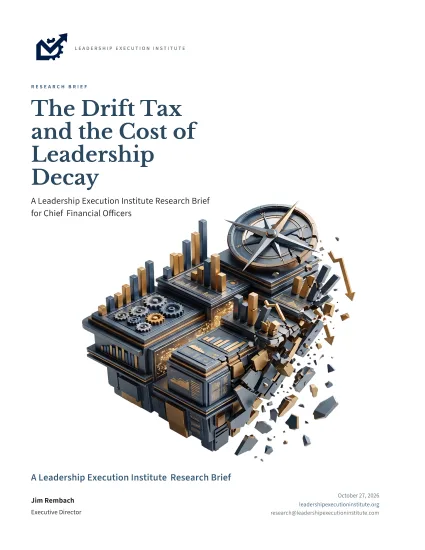
The Drift Tax and the Cost of Leadership Decay
Finance pays twice when reinforcement never follows the first capability investment.
About the Leadership Execution Institute
The Leadership Execution Institute is an independent research organization focused on leadership consistency, behavioral drift analysis, and execution system design. Its work examines how leaders decide and act under operational load, and how system design affects alignment, variation, and performance.
Media contact: Jim Rembach, Executive Director, Leadership Execution Institute, [email protected]