
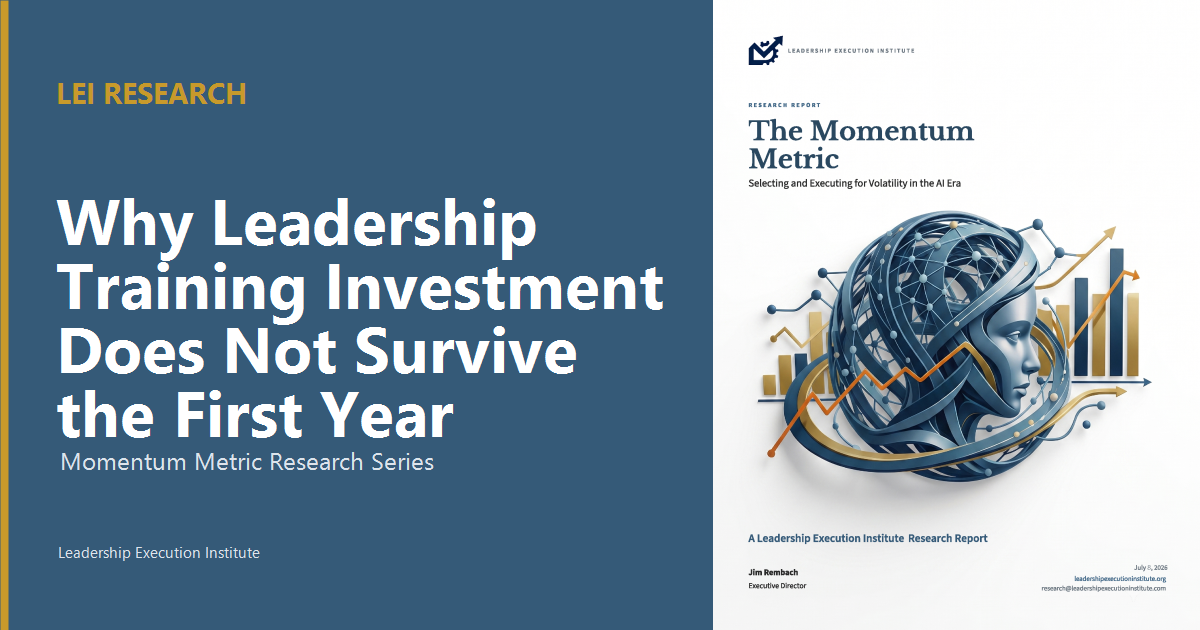
Why Leadership Training Investment Does Not Survive the First Year
Leadership Execution Institute research on why leadership training completion rarely predicts sustained behavior change, and what structural evidence associates with the gap.
The Leadership Execution Institute publishes research notes, analytical briefs, and updates on the evolving science of leadership consistency. This newsroom provides a record of insights, studies, and frameworks shaping how organizations understand Supervisor Drift, FONE Factors, and the role of Execution Systems in modern work.
New items are added as research develops, making this page a useful reference point for leaders, analysts, and researchers exploring the discipline of leadership execution.
Leadership Execution Institute research on why leadership training completion rarely predicts sustained behavior change, and what structural evidence associates with the gap.

Leadership Execution Institute research on why strategic intent stalls at the mid-management handoff, and what structural evidence associates with that failure point.

Research for CFOs and COOs on why AI pilot spend does not convert into profit-and-loss outcomes.

Leadership Execution Institute research on why enterprise AI pilot spend clears governance milestones without producing measurable profit-and-loss impact, and what structural evidence associates with that pattern.

The Leadership Execution Institute (LEI) published “The Talent Recalibration” to address an imminent structural vulnerability emerging across global enterprises. Organizations are currently dealing with the acute pressures of the “Triple Transition,” which refers to the unprecedented and simultaneous convergence of artificial intelligence acceleration, global energy restructuring, and geopolitical realignment. Because these macro-level forces are substantially … Read More
The convergence of intense environmental compression and the resulting inadequacy of legacy acquisition frameworks necessitates a fundamental recalibration of organizational leadership and talent selection. A comprehensive dimensional analysis conducted by the Leadership Execution Institute, detailed in the report The Talent Recalibration: Selecting for Biological Adaptability and Execution Readiness During the Triple Transition, examines why traditional … Read More

Independent analysis examines why legacy training fails to sustain consistency and introduces execution dimensions for distributed operations. GREENSBORO, NC, UNITED STATES, March 10, 2026 /EINPresswire.com/ — The Leadership Execution Institute has published a new research analysis examining the Nine-Factor Framework for determining the structural viability of leadership infrastructure and the elimination of Supervisor Drift. The … Read More
THE COLLAPSE OF THE COMPETENCE ASSUMPTION The Competence Assumption is the institutional belief that knowledge acquisition, or knowing, generates a direct and automatic correlation with behavioral consistency, or doing. Systems analysis indicates this model is observed to exhibit structural instability under modern operational velocities. Research from the Harvard Business Review (2022) identifies an Application Gap … Read More

Structural Cue Removal as a Catalyst for Operational Entropy The transition from co-located to distributed contact center environments represents a structural removal of environmental reinforcement cues rather than a simple shift in workplace location. In physical centers, organizational alignment often relies on Management by Osmosis, a proximity-based phenomenon where supervisors and agents absorb behavioral standards … Read More
THE SYSTEMIC COLLAPSE OF TRADITIONAL LEADERSHIP INTERVENTION The “Training Era” has entered a state of structural collapse, characterized by a systemic disconnect between educational inputs and operational outputs. Empirical data suggests that current models of leadership development operate with a high degree of inefficiency; according to the Harvard Business Review (2022), only 12% of skills … Read More